Sunday, 22 July 2018

Oneness of literature :~

Online discussion : Oneness of Literature :~

We find oneness in whole literature. All literature connected with each other.

T.S. Eliot's view ~

His work Tradition and individual talent, it's reflected to maximum influence of writer's past and experiences.
He said that no poets, artist of any art and has complete meaning alone, his appreciation is the application of his relationship with dead poets.

Northrop Fray view ~

His theory of Archetypal criticism that shows whole literature has oneness of it's existence and all share commonly.

'The West Land' by T.S.Eliot and Anton Chekhov's short story 'A Joke' we also find oneness of literature.

In The West Land we find this lines are connected with Chekhov's short story.

'And when we were children
 Staying at the archduke's
                            My cousin's he
 Took me out on a sled and
 I was frightened. He said Marie
 Marie hold on tight and
 Down we went.
           In the mountains there
           You feel free.'

This stanza shows the girl Marie's feeling like nostalgic and her experience for going to the mountain over the sled. She felt afraid but she got courage from his cousin. He gives her strength and she feels free.

Similarly we find in the short story 'A Joke' the same situation and incident in a girl Nadia.

She also feel like same situation in The West Land, she afraid like girl Marie. But she interest for sled and she doing it again and again.  During that time she felt that someone said her "I Love You Nadia". She confused that she thinks that it is reality or illusion. But after she realize that it's her illusion. No one speak that type of words.
So hear we can find the oneness between the poem and short story.

Sexual perversion ~

In the poem we find that sexual perversion as theme. This theme shows lustful desire and attraction. But Chekhov's short story have not found any kind of lust desire and attrection of man. At the end of story she married with other man still love her. This situation describe the reality of human relationship and selfless love.

So this type of comparison we find in both literary genre and shows oneness in it.

 ...... THANK YOU ......

Thursday, 19 July 2018

Movie review of 'MATILDA'

Movie review of 'MATILDA'


This movie is based on journey of little girl Matilda. The Movie shows the politically and humanitic satire.

First of all the movie started that shows the born of Matilda in hospital, but his parents were dislike that girl child. This seen shows gender difference.

Lonelyness ~
Every day Matilda's parents go to his work, and Matilda was lonely in his home but she likes that because she can do anything what she thinks. She makes food like pancakes and read books.

Reading books ~


She was like reading and she read everything like story, novels, poems, drama, fairytales and other things. But his father didn't like that reading. Everyday Matilda go to library for reading. The librarian tell her to borrow books and read at home.

Watching T.V ~
Parents of Matilda forced to watch t.v by her because she like reading. Parents thinks that why she read book, T.V Shows everything like book.

Introduction of school ~
Matilda thinks that she grown-up that she went to school, she create the school image of his mind like beautyfull garden, large play ground and good teachers. But her dream was break that she saw the school. But she like that place.

Comedy of school ~
First day of school, she enters the play ground that the principal miss Trenchbull (look like horrible and cruel) she gives to punishment of little girl to throwing her and this girl like flying and catch flowers that seen great comedy.

And another comedy is the prayer hall principal called the children Bruce, his eat principal's cake that principal gives the punishment of eat continually full cake(cake was very large).

Cheating with customers~
 Matilda's father runs the second handcar selling. But he cheat people, he used to fake part. He shows the business tricks of his son to how he earn to more Money. He cheats like car's part stick with superglu.

Negative character ~

Matilda's parents and his principal. The principal was very cruel woman, she always gives punishment of all student. Student create any Mistakes and problem that she give him hard punishment.

Positive character ~

Miss honey teacher of Matilda. She is good person, always take care of childrens. She knows that Matilda was very talented girl that she try to learn about her and his excellence show to his parents and principal but they ignore her.

Psychic power of Matilda ~

One day Matilda's father forcedly show the T.V that she can't look this and also she didn't like. Then she focus on mind his cruel family that his power works and break T.V. first of all she don't believe herself but some time past that she realize that do everything what she do. That's why she try to learn how to focus and control his power.

Happy ending ~

Matilda try to give miss Honey home returned by miss Trenchbull. Matilda makes plan and give his home back. And also miss Honey adopted Matilda to his family. And live happy life.

.....Thank you.....

I read some books like Sanjay Raval
"મને ગમે છે, તમને પણ ગેમશે", "હવે મને પહેલા કરતા સારૂ લાગે છે"
And also read book of મહ્મમદ માંકડ
"અંજામ"

Wednesday, 4 July 2018

Online discussion on Llosa's ideas :~

Online Discussion on LIosa's idea :~


Mario Vargas Llosa, the novelist, was awarded the Nobel Prize for literature in 2010. His most recent novel is "The Neighborhood." He was interviewed for The World Post by Michael Skafidas, a journalist and professor of comparative literature at the City University of New York.


This three points l like the most,.

I like literature that is still very close to living experiences. I don’t like very much the idea of the writer completely isolated, secluded in a library.

For the first time, in a culture that is totally global, without differences between East and West, we are all part of this new culture in which images are the great protagonists.

It is right to denounce abuses against women. These abuses are everywhere, so I have total sympathy for this movement as far as it is for more justice, more democracy, more equality of opportunities for women and men.

.......

Tuesday, 3 July 2018

Movie review of "Modern times by Charlie Chaplin" :~

Movie review of "Modern times by Charlie Chaplin"


This movie based on futuristic things and that quality shows in comic flow. The main character is Charlie Chaplain, he himself directed, produced and acted in this film.

About Modern Age :~

       The film shows vast development of machines and human life. The concept of film reflects advantages and disadvantages of human life and the use of machines and tools.


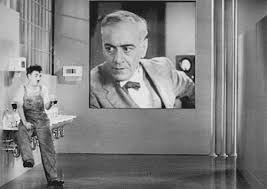
        This movie also shows the futuristic technologies like C.C.T.V Camera and other things. This technology is very effective to watch workers and it's working. The boss use camera system to watch every worker and it's work.

         The worker are supposed to work with the speed of machines. Factory master increase the speed of machines then it becomes difficult for workers to keeping piece with machines.

Workless people :~

        This movie also shows the workless people and poort to survive life. When the factory closed all the workers become jobless. They all become jobless and rise their voice for job, but no one can help them.

Red flag as a simbol :~


         Red flag is the sign to against the praesent Government. In the movie insidently Charlie becomes leader of unemployed group.

Story of Poor Girl :~


          The similar story like Charlie the poor girl and his family survive in face of poort and joblessness. She always search food and she also theft food for live life and survive. She is so kind that she also helps to another poor childrens to give them food and other things. She also face same difficulties like Charlie.

Personal life :~

        Charlie was happy in jail life. This place was given by him to enough food and good treatment that he was happy.
          Charlie helps the poor girl, then she realise he is good person.
          In other side he was happy because he returns to jail. We see in the movie Charlie tell to police officer : 'I am happy hear'.....

Surreal image :~


         This movie also shows sir real image.
*First in the factory when Charlie was engaged in work and lost his mind go inside of machines, this seen is unbelievable......
*Second time Charlie gets job at another factory, mistakenly he made his boss to go inside the big machine.


         The irony is that time is lunch time then all worker stop his work. They will not get one minute more of the lunch break that time machine also stop working.

The feeding machine :~


         The marketing officer came to show his new invention feeding machine. Factory owner like this machine, he thinks that save lunch break and worker do more work.
           Factory owner said to officer to show live demo of machine and this experiment done by Charlie. First of all machine works good but second round of experiment that machine made faluted and this seen genrated comedy.

White(Drug) powder :


          White powder means 'drug'. In the jail one peraon was drug habituated and this white powder just looking like Salt.
         Police officer came to check this man that he put all drug in salt bar.


Conclusion :~

         The movie shows the various things which indicates modern time like futuristic tools, machines, technology, unemployment and this all things shown by comic way.
          In the last part of movie is happy ending. At last the characters going towards nature.


.........


Monday, 2 July 2018

Movie review of "The Great Dictator By Charlie Chaplin"

Movie review of "The Great Dictator By Charlie Chaplin"


        This movie based on world war, it was the time when the second world war was about to starts. That time Hitler was at the top position in Germany. Charlie Chaplin has taken many sequence as a kind of parody from the  "Triumph of the wheel" in his film "The Great Dictator". "Triumph of the Wheel" is the Natzi Prapaganda movie .
Charlie Chaplin and Hitler-
Both have Same year and month of birth- April 1889, same physical appearance, same popularity. The character generated comedy.

Double role: opposite in nature :~

Charlie Chaplin Played double role in this movie.
The one is Hynkle the Dictator and the second one is Jewish Barber in the Ghetto. Both the characters are totally opposite in nature.

Reflection of Modern Age in the film :~

*Surreal effect :~

Means real but in a awkward way. In the movie when the plane of captain Schultz was flying along with the Barber and the captain himself then suddenly it turned down but still Both Jewish Barber and Captain remain in the sitting position without any effect this seems real but was only produced the surreal effect.

*Technology :~

In  the movie  there is huge machines used in wars to throw out Bombs, Bullets etc. This shows the huge development of machines in the modern era. Even their is scene of Radio also which cast the show Happy hours, but symbolically it indicates the sad hours.

*Pacifistic view :~

In the movie the character of the Jewish Barber shows the pacifistic view towards war. he never wants any kind of war. Even when he misunderstood as the dictator Hynkle and supposed to give speech on the victory over the Osterlich.

*Esoteric :~

Esoteric is the key term in the modern age. It means only few learner can understood, not understood by all.
We find the esoteric view when The Dictator hynkle giving the speech. He speaks Gibberish language which was not understood by all the peoples. But still peoples behave like that they understood each and every thing.

*Children and the leaders :~

       There was always a connection between the political leaders and the Children. In the film also we can find that after the victory how childrens are welcoming the dictator Hynkle and Hynkel also shows his great affection towards the children.


Conclusion :~

           In this way the movie  presents the condition of the modern age. And how the countrymen are suffering with the hazard of the war. How the spoiled leader controlling the weaker community and misusing their power. This film remains the great representative of the times and the last speech by the Jewish Barber remains the worthy speech till the present time.

..............

Wednesday, 4 April 2018

Paper no 7 = Topic : Queer Theory

Topic : Queer Theory

Definition of Queer Theory :
A definition of Queer is something odd or unusual, or is an offensive and derogatory term used to describe a homosexual....
Queer theory focuses on mismatches between Sex, Gender and Desire...
Queer is something that is, not normal or abnormal, worthless, strange, feared, questionable, odd, unconventional..

Meaning of Queer :Queer:- A broad level to define sexual and gender minorities who do not prescribe to binary normative or heterosexuality.
Homosexual :- An individual attracted to another individual of the same sex..
An approach that challenges dominant, social behavior and sexual identity based on heteronormative, binary opposites; Gay/Straight, Male/Female, Masculine/Feminine...
It is an interdisciplinary critical theory, that emerged in 1990 as a response to feminist theory and Gay and Lesbian studies..
It breaks from the binary heterosexual  normative and explores the fluid nature of sexual and gender identity. It was conceivable because the Gay rights movement in "Outed" diverse sexual and gender identities...
Queer theory is often used to designate the combined area of gay and lesbian studies together with the theoretical and Cultural writing..... --------- M.H.ABRAHAM
     Queer Theory critically examines the way power works to institutionalize and legitimate certain forms and expressions of sexuality and gender while stigmatizing others. Queer Theory followed the emergence and popularity of Gay and Lesbian Bisexual, Transgender, Intersex(now, LGBTI or Queer) Studies in the academy. Whereas LGBTI Studies seeks to analyze LGBTI people as stable identities, Queer Theory problematizes and challenges rigid identity categories, norms of sexuality and gender and the oppression and violence that such hegemonic norms justify. Often considered the "deconstruction" of LGBTI studies, Queer Theory destabilizes sexual and gender identities allowing and encouraging multiple, unfettered interpretations of cultural phenomena. It predicates that all sexual behaviors and gender expressions, all concepts linking such to prescribed, associated identities, and their categorization into “normal” or “deviant” sexualities or gender, are constructed socially and generate modes of social meaning. Queer theory follows and expands upon feminist theory by refusing the belief that sexuality and gender identity are essentialist categories determined by biology that can thus be empirically judged by fixed standards of morality and “truth.”

     We will begin the course by developing a critical understanding of Queer Theory through reading foundational texts by Michel Foucault, Judith Butler, Eve Sedgwick, Gayle Rubin and Leo Bersani. We will then examine the relationships between Queer Theory and other social and cultural theories that probe and critique power, privilege, and normativity, including critical race theory, transgender studies, feminist theory, and disability studies.

Queer theory :
     Queer theory is a field of post-structure critical theory. “Queer” is often used as an umbrella term by and for persons who identify as gay, lesbian, bisexual, intersex, and transgender, or by and for individuals who use the term as an alternative to LGBTI labels. Some find the term derogatory depending upon their race, class, personal experience, and also their generation. Recently, heterosexuals whose gender or sexuality does not conform to popular expectations have used the term “queer” to define themselves.
     Nearly one in every 2,000 people is born with variations in reproductive or sexual anatomy, or has a chromosome pattern that doesn’t fit with what is typically considered male or female. Such individuals are “intersex” — the “I” in LGBTI — and can identify as male, female or neither. Along with this people are struggling in many places for recognition, equality and their human rights. The intersex people are born with unique biological characteristics, they are different from transgender people, who do not identify with their assigned gender identity. Ironically, many intersex people receive unwanted surgeries and hormone treatments that transgender people have to fight for.

Queer theory as a part of study :
     Queer studies whose roots can be found in women’s studies, feminist theory, and gay and lesbian studies, as well as postmodern and poststructuralist theories. In 1991, Teresa de Lauretis used the words “queer theory” to describe a way of thinking that did not use heterosexuality or binary gender constructs as its starting point, but instead argued for a more fluid concept of identity.
     The works of Michel Foucault and Judith Butler are often considered the founding texts of queer theory. Lauren Berlant, Michael Warner, and Eve Kosofsky Sedgwick are also major early writers in defining queer theory. Queer theory argue that it prompts the acceptance and understanding of a more complex reality in which we live. Queer theory provides scholars, activists, and others ways of thinking and talking about identity beyond simple binaries especially in fighting homophobia and transphobia, which are unreasoned fear and hatred towards homosexuals and homosexuality, and transsexuals, transsexuality, and transgender people, respectively.

Writers of Queer Theory :
Michel Foucault :
Judith Butler :
Eve Kofosky Sedgwick :
Gayle Rubin  :
Leo Bersani :
Lauren Berlant :
Lee Edelman :
Jack Halberstam :

The rise of new gay and lesbians stereotypes :
     Recently, the rise of two new types of gay man - what I call the 'girl's best friend' and the 'lifestyle gay' - has been conspicuous. Gay men as girl's best friends have appeared in movies, to name just a few, such as Julia Roberts' and Rupert Everett's My Best Friend's Wedding, Madonna's and Rupert Everett's The Next Best Thing and Jennifer Anniston's and Paul Rudd's The Object of My Affection and, perhaps with the most impact, in the TV series Will and Grace - which offers best friend relationships not just between Will and Grace but also between Karen and Jack.
      In these cultural products, gay men are overwhelmingly associated with fashion, style and consumption - characteristics which render them of interest to women and whose best friends they become. The gay men in these media rehearse both what we already 'know' about gay men while simultaneously reinforcing received notions about what it is to be 'a homosexual' - that is, particular looks, movements, patterns of voice, manner of dressing, lifestyle choices and consumption patterns which are coded as homosexual are offered up as evidence of a character's homosexuality.
      For instance, you may remember how Reese Witherspoon in Legally Blonde solves the murder mystery. She realizes that the wife could not have been in a sexual relationship with the Latino pool boy as alleged by the stepdaughter since the pool boy is, in fact, gay. She deduces this from the fact that he recognizes the label of her designer shoes - something which a heterosexual man would be, apparently, incapable of doing.


The problem with stereotypes :
       In the case of the movies and sitcoms discussed earlier, the homosexual characters are scripted by writers who need to create clearly recognizable and digestible 'types' but the same is no doubt true of Warren and Gavin, a 'real' gay couple. Take their performance of 'the gay couple' on The Block - we must ask why precisely this couple was chosen - they clearly had the required 'look'; also, to what extent did their awareness of being on camera affect their performance of gayness and to what extent was that performance scripted by the show's producers and created by judicious editing to replicate the stereotype - what we already 'know' about gay men? How does a stereotype function?
       Cover suggests that a stereotype, 'whether harmful and negative or harmless and positive, will reduce a set of ideas into an easily communicated and culturally intelligible image, stemming the flow of signification and constraining the possibilities for diverse subjective performances'. Sara Schulman’s anxiety about the circulation of 'fake' homosexual images suggests that these images depict or connote narrowly commoditized notions of homosexual life and of an openly gay identity.
Queer theory and the problem of 'identity' :
       Queer theory is not about advocacy - it does not argue that the portrayal of a more diverse range of gay men and lesbians in public culture would somehow solve the problem of representation - the image of the 'fake' homosexual is not challenged by the production of more 'real' ones. Nor is queer theory related to psychoanalysis, it does not look for 'causes' of homosexuality in either the individual or collective psyche and does not seek to liberate an individual's 'true' sexuality. Queer theory instead offers, to borrow a term from Foucault, a genealogical critique which refuses to search for an origin of an individual's sexual orientation, a genuine or authentic sexual identity that repression has kept from view; rather a genealogical critique investigates the political stakes in designating as an origin and cause those identity categories that are in fact the effects of institutions, practices and discourses operative within the wider society. Queer theory concerns itself with the effects which arise from modern societies' preoccupation with consigning individuals into two opposite and mutually opposed camps on the basis of the gender of their preferred sexual partners. As Eve Sedgwick comments:
       It is a rather amazing fact that, of the very many dimensions along which the genital activity of one person can be differentiated from that of another precisely one, the gender of object choice, emerged from the turn of the century, and has remained as the dimension denoted by the now ubiquitous category of 'sexual orientation'.

Indian view of Queer theory :
Hinduism has taken various positions, ranging from homosexual characters and themes in its texts to being neutral or antagonistic towards it.
Rigveda, one of the four canonical sacred texts of Hinduism says Vikriti Evam Prakriti (Sanskrit: विकृतिः एवम्‌ प्रकृतिः, meaning what seems unnatural is also natural).
 which some scholars believe recognises homosexual/transsexual dimensions of human life, like all forms of universal diversities.
Famous movie of Queer theory :
An example  of the fluidity of gender/sexuality can be seen in the character of Captain Jack Sparrow in the movie...
 In  this film the main character Jack uses an ironic and 'over -the-top' performance of a pirate.
Includes wearing an over- elaborate costume and eye makeup, using feminine and camp gestures and avoiding anything that could be interpreted as machismo...

Examples of Movie :
Fire, Dostana, Margarita with a straw, Un-freedom..., Kapoor and Sons, Heroin, I am Michel and other movies

Examples of TV shows :
Shakti-Astitva ke Ehesas ki... , I love us, Aatma Parichy, and other…..

Conclusion :
        This paper has given a very brief outline of some applications that can be made of queer theory to popular culture. Rather than a mode of analysis, like psychoanalysis, which attempts to discern a hidden 'reality' behind media representations – that 'everyone is really gay', for instance, queer theory is a heuristic approach which enables questions to be asked about why we choose to emphasize some and not other aspects of an individual's life when trying to give an account of who they are. As John Phillips (this volume) shows, queer theory is not interested in investigating the largely anachronistic question of which composers are 'really gay', or of elucidating how their same-sex desire can be decoded from their compositions. Just as feminism has problematized the notion of gender, looking at how society is fractured along the lines of perceived gender difference, queer theory takes the notion of sexuality, and inquires what the consequences are of placing a person on one side or the other of the hetero-homo binary. Rather than searching for the meaning in sexual orientation, queer theory encourages us to consider how sexual orientation is made to signify a range of meanings about the self. 

Paper no 8 = Topic : Two characters in Hamlet marginalization with a vengeance

Topic : Two characters in ‘Hamlet’ marginalization with a vengeance.
Preface :~
In several instances earlier in this play ‘Hamlet’ in we can see that culture and new historical emphases on power relationships.  Let us now cultural in practice to hamlet in two minor characters to who does to Shakespeare’s hamlet in marginalization with a vengeance. And also context to power, political indeed on all matters that deeply affect people’s ideas and it may that to people power to society marginalized people. The most influential w<riter in all of English literature, William Shakespeare was born in 1564 to a successful middle-class glove-maker in Stratford-upon-Avon, England. So now shortly after the play ‘Hamlet’ within the play and Claudius is taking privately with Rosencrantz and Guildenstern, hamlet’s fellow students from Wittenberg. In response to Claudius’s plan to hamlet to England so now see to this context in two characters Rosencrantz and Guildenstern in cultural context and practice to hamlet.

Cultural approach and practice to culture in ‘Hamlet’ :~
      Shakespeare’s most of the work in human studies and also he observes  were motivated by an educational and political ideal called (in Latin) humanity the idea that all of the capabilities and virtues peculiar to human beings should be studied and developed to their furthest extent. In several instances earlier in this chapter we noted the cultural and new historical emphases on power relationships. Now, let us approach Shakespeare’s Hamlet with a view to seeing power in its cultural context.
Two marginalized characters in Hamlet: Rosencrantz and Guildenstern :~
        In several instances earlier in this chapter we noted the cultural and new historical emphases on power relationships. Now, let us approach Shakespeare’s Hamlet with a view to seeing power in its cultural context. To say that the mighty struggle between powerful antagonists is the stuff of this play is hardly original. But our emphasis in the present reading is that one can gain a further insight into the play. In the 20th century the dead, or never-living, Rosencrantz and Guildenstern were resuscitated by Tom Stoppard in a fascinating re-seeing of their existence, or its lack.
       In this play in hamlet we see that to two characters Rosencrantz and Guildenstern in also the king Claudius use to power in this persons and it may be that to political and culture ideas in  this text. We know that true reality to hamlet in his life his friend also his favor but in power position king Claudius in between to sent England and his ambitions to kill hamlet into his friend.  In response to Claudius ‘s plan to send hamlet to England , Rosencrantz delivers a speech that if read out of context is both an excellent set of metaphors and a summations of the Elizabethan concepts of role and  power of kingship:
The singular and peculiar life is bound
With all the strength and armor of the mind
To keep itself from noyance but much more
That spirit upon whose weal depends and rests
The lives of many .the cease of majesty
Dies not alone, but like a gulf doth draw
What’s near it with it? It is a massy wheel
Fixed on the summit of the highest mount,
To whose huge spoken ten thousand lesser things
Are mortised and adjoined; which, when it falls,
Each small annexment, petty consequences,
Attends the boisterous ruin: never alone
Did the king sign but with a general groan.
In this passage we can see that thoughtful and imagistically successful passage worthy ofa wise and accomplished statesman. It wants us to have a lance at once marginalized characters we are not given enough important and those who should have been given recognitions in their lives. In that culture I ‘Hamlet’ political. In other word, Power and indeed on all matter to hand of the king. But how many readers and viewers  are of the play would rank this passage among the best-known lines of the play and also with Hamlet’s soliloquies  for instance or with the kings effort to prays, or even with the aphorisms addressed by Polonius to his son leartes? We know that venture to say that the passage intrinsically good if one looks at it alone, is simply not well known.
In spite of having access of excellent they have been marginalized and hamlet being a hero. From a wealthy and royal family has been put into category of a moral hero. Who has a few lacks also? The questions arises about the people will be notice it? The agreement is only a reaffirmation of what they had told the king when he first received them court. The two are distinctly plot-driven: empty of personality, sycophantic in a sniveling way eager to curry favors with power even if it means spying on their erstwhile friend. They admit without mush skill at denial that they ‘’were sent for’’. So that meaning of there are less successful and also they try to play on hamlet’s metaphorical ‘’pipe’’ to know his ‘’stops’’ when they are forced to admit that they could not even handle the literal musical instrument that Hamlet shows them. still later these nonentities  meet their destine ‘non-boringness’ as it were when   hamlet  who, can play the pipe so much more efficiently  substituted  their names in the death warrant intended for him.
So that in this Rosencrantz and Guildenstern report back to King Claudius after their conversation with Hamlet They have very little to tell the King, who opens the scene by asking. The only good news they have for the King is that Hamlet was greatly cheered to hear about the arrival of the traveling players and that he ordered them to put on a performance. Claudius is very pleased to hear about this show of interest on the part of his melancholy stepson. And also we see to Claudius power to this two people and hamlet also remembered to these ideas in his mind. And also see that conversion to Claudius and Rosencrantz like that:
"And can you, by no drift of conference,
Get from him why he puts on this confusion,
Grating so harshly all his days of quiet
With turbulent and dangerous lunacy?"
Rosencrantz says,
"He does confess he feels himself distracted,
But from what cause he will by no means speak."
And Guildenstern adds,
"Nor do we find him forward to be sounded,
But with a crafty madness keeps aloof
When we would bring him on to some confession
Of his true state."

The King's interview with Rosencrantz and Guildenstern. Nothing much is accomplished except to establish that the King and Queen will be attending the play Hamlet has ordered the players to perform. In play these nonentities meet their destined “non-beingness” as it were, when hamlet who can play the pipe so much more efficiently substitutes their names in the death warrant intended for him. In say something Rosencrantz and Guildenstern also to struggle and to say that the mighty struggle between powerful antagonists is the stuff of this play is hardly original. But our emphasis in the present reading is that one can gain a further insight into the play. In last of the play into inform to hamlet his friend are death. Both are distinctly plot-driven: empty of personality, sycophantic in a sniveling way, eager to curry favor with power even if it means spying on their erstwhile friend. In a moment of trickery on his own part, Hamlet blithely substitutes a forged document bearing their names rather than his as the ones to be “put to sudden death, not shriving time allowed” when horatio responds laconically with so Guildenstern and Rosencrantz go to hamlet is unmoved, and last as well as Shakespeare mind to ‘hamlet’ is done with these two characters “they are not rear, conscience”. And last this two are death between to power and it may be that marginalized are not social support and both are death in end the play.
Death of Rosencrantz and Guildenstern :~
In this play in cultural studies to practice into cultural approach and such some example and also wrote to Tom Stoppard play in protagonist to this two characters Guildenstern and Rosencrantz. It is instructive to note that the reality of power refractive a Shakespeare time might in another and culture reflect a radically different worldview. Let us enrich our response to hamlet by looking at related culture and philosophical manifestation from the 20th century. In 20th century the dead or never living Guildenstern and Rosencrantz were resuscrited by Tom Stoppard in a fascinating re-seeing of their existence it lack. In Stoppard’s version they are even more obviously two ineffectual pawns, seeking constantly to know who they are here and where are going. Whether they “are” at all may be the ultimate question of this modern play.
In “Rosencrantz and Guildenstern are dead”, he has given the contemporary audience a play that examines existential questions in the context of a whole world that may have no meaning at all. Although it is not our intentions to examine that play in great detail. And also marginalized two person view and it may be that Guildenstern and Rosencrantz are archetypal human beings caught up on a ship and also should been spaceship earth for the 20th or 21th century that

Assignment paper 15 Mass media & communication

Name : Makwana Vijay K. Sem : 4 Roll no. : 34 Email Id : vijaykm7777@gmail.com Enrollment no. : 2069108420180035 Submitted to : Depart...